A candid conversation with DePaul University’s leader on higher education, the state of international students, the basketball facility and his response to student pushback.
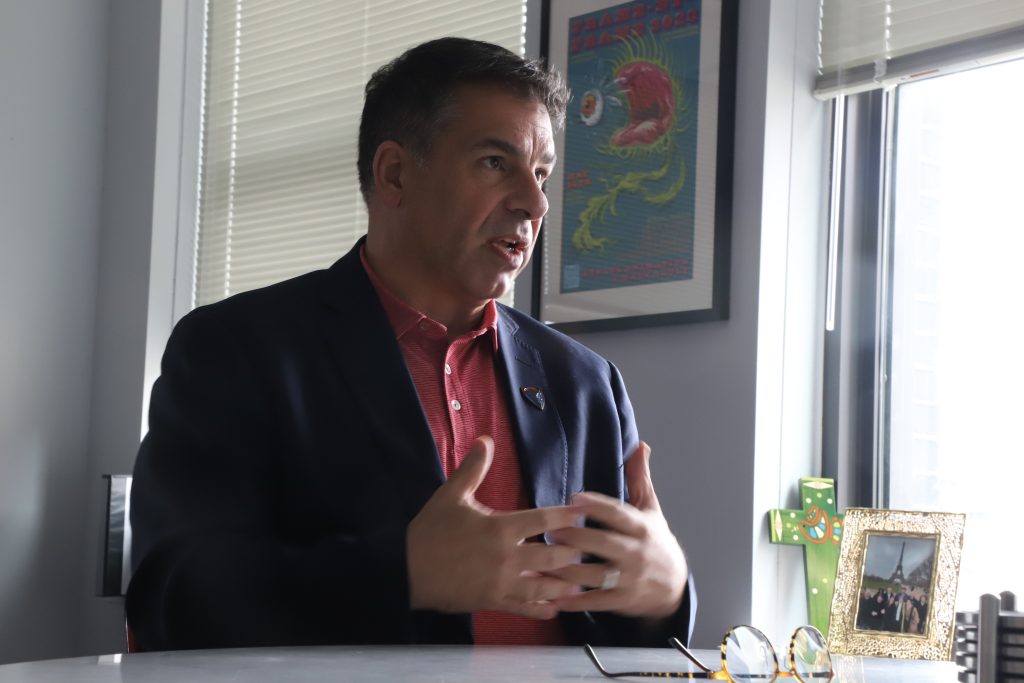
DePaul President Robert L. Manuel knows what it looks like when a campus is under a microscope. During a complex period of change filled with governmental pressures and constant campus dialogue, Manuel is redefining higher education.
To discuss a path forward, Manuel sat down with student media outlets in a conversation where no topic was off-limits — spanning everything from student pushback to the strategic mindset behind reaching into the Big East market.
At the top of the Richard M. and Maggie C. Daley Building sits a powerful and colorful corner office. Stepping inside, your eyes naturally gravitate towards the three square windows overlooking the surrounding skyscrapers.
For Manuel, it’s in this room that the real work gets done. However, the idea of how that work happens is changing. As higher education undergoes constant pressure to meet modern demands, DePaul stands out for maintaining qualities that are the building blocks for the future.
The conversation dates back to the ‘90s, when technology began to bore its way into classrooms. At the time, colleges believed that traditional topics like English, history and philosophy were essential in professionalizing students.
This idea is most commonly known as perennialism and defined as an educational philosophy focused on the timeless truths and universal ideas rather than modern social trends.
It was championed by many educators but more specifically, Robert M. Hutchins, who during his time as president at University of Chicago took it to a higher level and did away with non-intellectual activities. Now, we see it in Manuel’s presidency on a much calmer scale.
Manuel talks about how being able to think, reason and write helps individuals “understand nuance versus the binary nature of the world.” With each era in education, it’s the one constant that hasn’t lost its importance.
This philosophy doesn’t need to be remade but rather preserved because, at a time when the liberal arts are “under attack,” the importance of higher education is reinforced.
This is especially true at a time when the current Trump administration is redefining what degree programs are considered “professional,” resulting in greater financial burden on students and leaving many in a vulnerable position.
“Everything we’re doing in interdisciplinary education requires that you have good disciplinary skills to lay it on. If you don’t have a good English department, or a good history department, or philosophy, you’re not going to have good abilities to do this interdisciplinary work, and that’s kind of where the future of the university is going,” Manuel says.
That ability is what gets DePaul out of the “undifferentiated middle,” a term Manuel uses to explain how certain institutions may be known for their prestige while others by content, impacting what people believe to be a “quality” institution.

When “quality” comes to mind, one may think of places like Harvard, Yale and Columbia for their prestige. While Manuel recognizes that DePaul won’t ever be as selective as those institutions, it can still be as impactful.
Regardless of Ivy League status, the influence DePaul leaves individuals with is outstanding. For example, at DePaul, Pell eligible students graduate at 20% higher rates than any other school in the country.
Manuel adds, “The concept of what a quality [higher education] institution is is changing. Now they’re moving [away from prestige] to impact … and we stand out in [that] the social mobility, the socioeconomic status, the life chances you have because you came through DePaul are far greater than if you went anywhere else.”
Yet while Manuel works to always adapt to the ever-changing landscape of education, there’s a community at DePaul that may not be able to experience the fruits of his labor — international students.
Amid the crackdown on immigration, the Trump administration has created restrictions for international students in an attempt to also “reshape higher education.”
These restrictions include revoking the visas of thousands of international students, deporting some of these individuals and most recently proposing an idea that would require schools to pay a $70,000 fee for an optional practice training program (OPT).
This program allows students to work in a job tied to their major during or after their time in college for a limited time. However, if this new fee proposal is approved, along with an additional $30,000 fee for each renewal, this program would be largely inaccessible to many students, further decreasing their abilities to succeed in the United States.
When looking at its effect on DePaul, Manuel notes that in the past two years, the school has seen a roughly 80% decline in international graduate student enrollment. This decline led to an immediate reduction in spending to meet financial commitments, per a 2025 message from the president.
In response to these governmental pressures, the university has made an effort to remodel career services to best match students with corporations that help with visa processing. Additionally, they aim to hire students to complete in-house demands and create advocacy groups like Human Dignity Advocates.
With all this fear, Manuel empathizes: “I can’t change the laws, but I can be better at providing the human support that they need to feel comfortable and supported during the times when the laws may not do that. It’s the difference between being able to cure and being able to care.”

As schools like DePaul continue to fight for the voices of international students, there are other aspects that keep the community hopeful.
In September 2023, DePaul University officials announced its plans to build a basketball practice facility on the corner of Sheffield Avenue and Belden Avenue. Raising around $50 million through philanthropy, the facility is an opportunity to invest in the university’s brand, connectivity and self-generated revenues,” according to a Campus News post.
With this new space, athletes will have an area to train in, as well as spaces for team dining with a nutrition bar, sports medicine treatment, hydrotherapy, a weight room, and meeting rooms. On top of those amenities, they will include a space dedicated to health and wellness for more than 215 student athletes along with a broadcast production studio.
“What really makes [each student] unique matters, and schools without any kind of differentiation in their product or their experiences are having a hard time getting students to want to come. This is an opportunity and a lever we have to pull that a lot of institutions don’t,” says Manuel.
Ultimately, the facility was born with the idea of reaching out to prospective students who are interested in sports, with the intent of diversifying the interest of the student body, as well as to better position the teams that compete in the Big East Conference.
Vice President and Director of Athletics DeWayne Peevy said, “The new facility will provide our student-athletes with a cutting-edge training environment where they can thrive academically and athletically.”
The facility officially broke ground just last month and plans to open its doors in the fall of 2027.
But not all students were supportive or happy about the new facility, especially with budget cutbacks in other parts of the university. On a DePaulia Instagram post regarding the facility, several comments voiced their frustration with this development, discussing changes like the laying off of over 100 staff members last December, as well as library cutbacks and the closing of the DePaul Art Museum and the Merle Reskin Theater.

When asked about these criticisms, Manuel says, “I’ve actually been pretty comforted in the fact that the middle 80% of our population understands that these are not DePaul problems; these are America problems that DePaul is experiencing.”
With this estimated percentage, he goes on to explain that even surrounding colleges like Columbia, Roosevelt, Dominican and Loyola are experiencing the same issues; they are just manifesting differently.
As a Massachusettsian, he speaks in sailing terms: “The storm is the same, but the boat we have to sail in is very different. Our boat is very strong right now; it’s not leaking water, but we’re in wicked, tumultuous times.”
To be clear, there are always going to be conversations about money, whether that’s saving or spending. Manuel’s focus now is trying to get to a place where there don’t need to be any more layoffs.
His team created a “values-based budget based on commission” with the intent of showing the board that being open to investment is much more valuable than budget cutting to a high degree.
But Manuel isn’t unfamiliar with critiques of his presidency — especially in the past couple of years when DePaul has seen an encampment, many protests and ICE presence on campus.
From his perspective, his team has been very open to comments, criticisms and critiques, no matter how bad or difficult they are to hear. Even going forward, it’s something that he wishes to continue to take in.

“There’s a difference between not being heard and not getting your way. And there are moments when the information that’s coming to me changes the course of action that we’re on, and there’s places where it doesn’t,” Manuel explains. “We’ve got to come to an understanding that both can happen, and sometimes you’re heard and change [happens], and sometimes you’re heard and it doesn’t change.”
Regarding a focus on sports, even as a liberal arts school, Manuel reasons that there’s been an even investment in many parts of the university, like marketing programs, human dignity groups and CDM support. It just comes down to “some people are way more interested in certain pieces than they are others.”
In the end, Manuel can’t imagine DePaul without the arts, and while the future of things such as DPAM remains unclear, he stays hopeful that what makes us great won’t go away.
“This is very clearly a rudder to what we know makes us good and great, and is not something we’re giving up on. It’s something we have to rethink and reimagine.”
Header Image by Seren Winslade
Be First to Comment