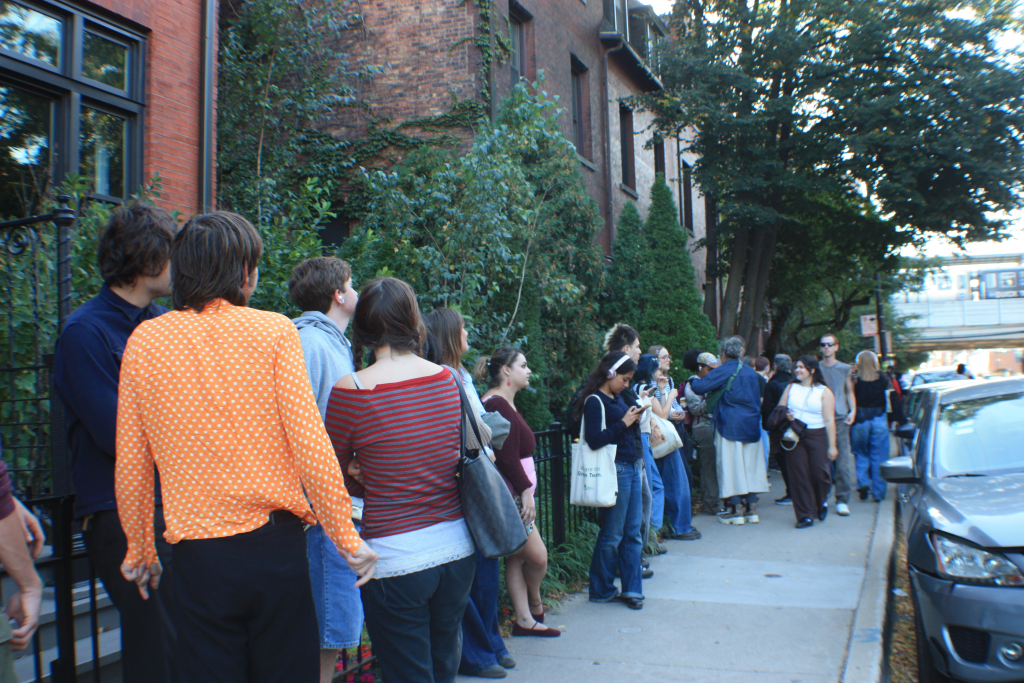
DePaul students and faculty cultivate in solidarity to support the preservation of art through a peaceful line demonstration after DePaul Museum’s closure.
On Thursday, Oct. 8, from 5 p.m. to 6 p.m., DePaul students and faculty gathered outside the DePaul Art Museum in a demonstration to protest the university’s decision to close the museum.
“We’re all just kind of standing here in solidarity … it’s nice seeing everyone here,” said Ben Wartz, a DePaul senior studying philosophy who lost his job at DPAM due to the closure. “Seeing that the closure did, in fact, matter and impact people — deeply enough to where they’d stand in line on a Thursday night for seemingly no reason.”
On Feb. 26, 2026, DePaul President Robert L. Manuel announced the school board’s decision to cut funding for the museum. The museum closed on June 30 the same year.
The decision to discontinue the financial support of the museum was due to budget adjustments needed to maintain the university’s 2026 fiscal year budget due to plummeting international student enrollment and rising health care cost.
Demonstrators stood outside the museum as a way to display the cruciality in preserving the museum as a valuable asset for the university and its students. For students, the museum was a place for them to learn and congregate with others passionate about diversifying art.
“It was free, open to everyone,” said Wertz. “You could go through it. You could look, you could observe. You could understand the politics being expressed through the art, and have your own political relations, then with it, and then have people to talk about it with.”
Wertz found catharsis through the museum, as it relieved his anxieties around his relationship with art. Since working there, through collaboration and dialogue with coworkers and visitors, the museum helped him find his own personal belonging in the art world. However, Wertz notes that the closure had an adverse impact on the melting pot this space created by being a hub for non-judgmental conversations that confronted social issues.
“It was just a place where the collaboration, where those voices, where anyone, no matter who they were, whether they were the richest of the richest, or the poorest of the poorest, that could come in, and just talk.” said Wertz. “Cause that’s what’s most important.”
The museum, built in 2011, gave free admission to the Chicago public and had over 4,000 art pieces in permanent residence in the gallery along with three to five exhibitions per year. The museum dedicated its exhibitions to spotlighting underrepresented artists, which committed to the importance of inclusion and diversity within art culture.
The DPAM exhibitions and pieces conjured conversation between people of all backgrounds. They promoted equality as principle where any student or member of the public could arrive and be met with respect for their backgrounds. This inclusivity attracted diverse discussions and perspectives, giving many an opportunity to empathize with others’ experiences through art.

Kayla Bland, a DePaul junior studying art history and minoring in museum studies saw the museum as a huge opportunity for art majors to find a step into the work field of art. Bland credits art students as being an integral part of the school’s overall campus life.
“A lot of people find themselves represented in museums, like the DePaul Art Museum…” said Bland. “Especially at a private university, like DePaul, in this specific setting [the protest], these people, here, are the reason that this institution runs.”
As the DPAM’s closure broke news, the issue became politicized due to student discussions about its impact on the schools culture and how that relates to the importance of art in establishing a voice in politics.
“As museum spaces become more and more progressive and actively political, because museums are political spaces, this feels like a way to silence more voices,” said Bland. “The first thing that DePaul University did when federal funding was pulled was shut down the museum that stands for diversity and inclusion.”
Bland expressed the purpose of the demonstration was to display pushback to the board’s decision and communicate the students’ frustrations — to convey that the money they put into the school requires their voices and perspectives to be considered pertaining to decisions like these.
DePaul history professor Gene Beiriger reinforced this idea, explaining that demonstrations, silent or vocal, are a way to express solidarity within the school’s population.
“There are people out there who care, and it’s not just something that a decision can be made, in isolation,” said Beriger. “And then people don’t respond, and so they believe that it’s okay, nobody cares … They need to know that, in this case, they made the wrong decision, and there are people who care.”
Beiriger emphasized the cruciality of art in curriculum and how it should be a privilege for college students to have access to a culture that welcomes varying, and sometimes controversial, political ideologies and beliefs, precisely what the museum represented.
“Especially because it’s a college, and because it has students, and because where else will you have it,” said Beriger. “And where will you have it affect so many people at an age when they were curious, they’re intellectually challenged, and they want to get engaged?”
According to Beiriger, museums allow its viewers to be exposed to things people aren’t familiar with, sometimes even making them uncomfortable. This discomfort can foster more creativity and translate into critical-thinking by having more open-minded discourses about the social and political world in a professional space.
“It isn’t presented that way, but it is a sort of censorship,” said Beiriger. “There are other decisions that one can make regarding cuts that have to be made. Making it to art is a statement. And the statement may not be intentional, but it may be intentional. But the impact of that decision is important.”

Brother Mark Elder, one of the protest coordinators and an art professor at DePaul, believes that art is a beneficial way for people to connect with themselves.
“Art making is dealing with problems, and problem solving,” said Elder. “And then realizing that part of that is what we do in life, anyway. And it is the best way to express your deep most feelings about things that are important.”
As one of the coordinators, Elder admits that he and his companions hold out faith that they can find a way to reopen the museum and the protest was a way to draw attention to the optimism they all feel.
The museum is still open for appointment only, and the archive collection, according to Manuel’s official statement, ‘will continue to serve as an asset to DePaul,” which many believe is an essential resource that should be protected and continue to be accessible to all students.
“This is fundamentally a liberal art school,” said Wertz. “And the liberal arts will be protected. Whether that’s institutionally, which isn’t happening, or whether that’s community, and that’s what’s happened.”
Header Image by Avari Chayse Edwards
Be First to Comment